8 Hard-Earned Truths from 8 Years at Meta

Featured

At Meta we celebrate Metaversaries. 8 years ago today, I joined Facebook. Keeping up with my annual tradition, I take time on this day to step back and reflect on what I’ve learned over the past year.

Year 8 was easily one of the most challenging years in recent memory. Beyond a war, the macroeconomic climate, industry layoffs, the rapid rise of AI, and global turmoil, there were also many quieter, internal shifts that tested my resilience. Navigation during turbulent times isn’t easy, but it is deeply instructive.

Here are 8 hard-earned truths from my 8th year at Meta:

  1. Don’t fall for vanity metrics. It is easy to celebrate flashy surface-level numbers. The temptation is to treat metrics that are easy to track as core goals—until those proxy metrics become the target, optimization turns into gaming, and the whole system strays off course (just ask Goodhart). Genuine progress isn’t measured by easy counting; it is measured by sustainable impact, real utility, and long-term value creation. Nothing less, nothing more.
  2. Building (with AI) is fun again. Building has moved past the honeymoon phase of novelty. The initial thrill of “magic” has been replaced by the far deeper satisfaction of utility and craft. For a long time, I stepped away from hands-on building for all the usual reasons—time constraints, setup friction, and overhead. But tools like Claude (and Muse since it was hatched) changed the equation: they stripped away the setup friction, handled the tedious implementation details, and drastically shrank the gap between an idea and a working prototype. It freed me up to focus on product thinking, creative problem-solving, and user experience rather than getting bogged down in boilerplate syntax. I was able to revive old side projects, build utility tools I’d been wishing for, and even push code to production for the first time since my onboarding week.
  3. Endless learning. Change has been a constant throughout my career, but the sheer velocity of shift this past year raised the baseline—learning new things felt like table stakes just to stay afloat. The real currency hasn’t just been knowledge, but adaptability. Stagnation is no longer just standing still; it is actively falling behind. Staying curious, investing time to understand how new tools work and what they can offer, and constantly questioning my own assumptions became a weekly ritual rather than an annual reflection. We are playing Alien Chess, after all.
  4. Having opinions is sexy again — don’t delegate your critical thinking. In an environment saturated with agentic data collection and automated analysis, human judgment is now at a premium. While AI can build whatever you ask for—and even generate the documentation to justify it—it takes conviction, intuition, and strategic clarity to define what actually matters. The temptation to let automated consensus or processes make the call is high, but the most crucial decisions still demand a point of view: one informed by data, but owned entirely by you.
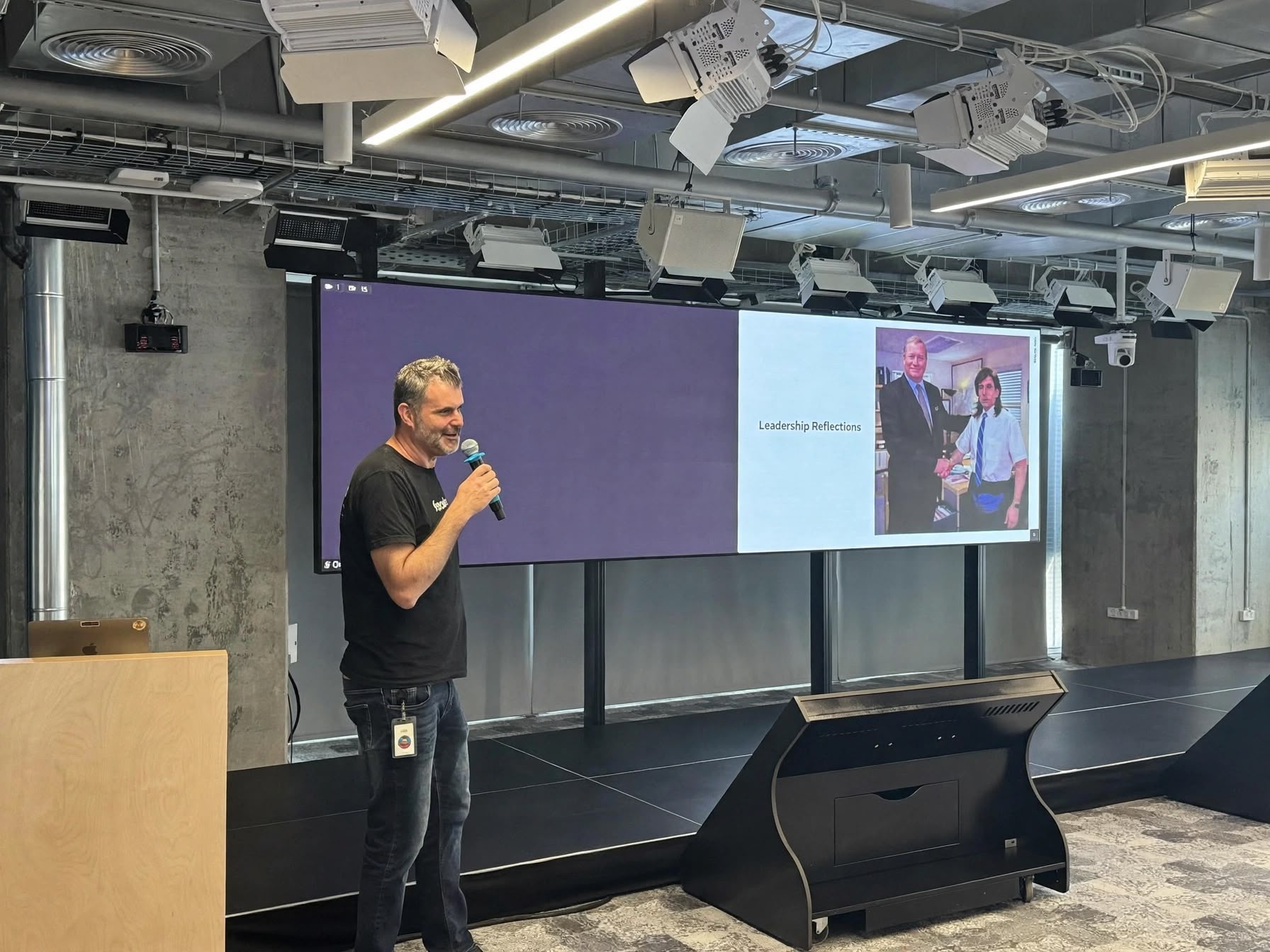

  5. Leading at a time of turmoil. Leading when everything is calm is challenging; leading through layoffs, strategic pivots, and global tension redefines the entire job. It requires providing psychological safety while remaining uncompromising on standards. I learned that during periods of extreme turbulence, your team doesn’t need false certainty or rehearsed corporate speak—they need radical transparency about the challenges ahead, absolute clarity on what matters today, and a steady hand on the wheel when the map keeps changing. This past year reinforced that it is precisely in the most troubling times that true leaders surface—not by avoiding the storm, but by being the calm reference point that others can anchor to.
  6. From chatting to delegating. This year, my relationship with delegation evolved fundamentally, applied equally to how I lead people and how I leverage AI. In both interfaces, it shifted away from narrow directives, frequent check-ins, and ongoing alignment. Instead, I was delegating entire bodies of work and taking myself out of the loop. When you step back from managing how the work is done, establishing clear intent, boundaries, and measurable objectives becomes absolutely critical. This high-trust, outcome-focused model is the only way to scale—whether you are leading a talented team or directing agentic systems.
  7. Communication is the ultimate hard skill. We often label communication as a “soft skill”, but in times of rapid change, organizational restructuring, and high ambiguity, it is the hardest technical discipline there is. Technical expertise gets you in the room, but precise, empathetic, and transparent communication is what actually drives alignment and moves mountains. When everything is in flux, ambiguity is toxic—and the ability to frame complex problems, deliver hard truths with candor, and align diverse teams behind a single intent becomes the ultimate high-leverage skill.
  8. Culture is built over years and can be shattered in one decision — values are the most important thing that brings people together. Strategy, organization charts, and product roadmaps evolve constantly, but culture is often assumed to be an enduring constant. However, culture is fragile. It takes years of consistent choices, trust-building, and shared experiences to cultivate, yet a single decision can break it overnight. When structural shifts or rapid change disrupt the familiar culture, you can’t rely on office perks or old routines to keep people together. In those moments of transition, it’s core values—the foundational principles of how we act and treat each other—that are the anchor that keeps people grounded, aligned, and united. And if those core values are scarce, retention becomes an uphill battle.

Entering Year 9 means that Meta is officially becoming the longest I have ever stayed at a single company. Crossing that line says a lot about this place, the great people I work with who make it worth showing up for every day, and how much I’ve grown along the way. Onward!

The 10x Trap

Featured

A post written by Meenakshi Tripathy reminded me of an old Meta motto: you shouldn’t confuse speed with progress.

Personally I’m less concerned about PMs writing code to production. Because PMs should, and will, focus on orchestration. I worry about Engineers writing 10x more code, because, well, they can. And are also, in 2026, expected to.

We’ve all seen the demos. An agent spins up a plan, touches 15 files, and hands you a completed feature in 45 seconds. It feels like 10x. But in a high-scale environment 10x speed without 10x rigor is just 10x gap.

“Speed is the form of ecstasy the technical revolution has bestowed on man. As opposed to a motorcyclist, the runner is always present in his body, forever required to think about his blisters, his exhaustion; when he runs he feels his weight, his age, more conscious than ever of himself and of his time of life. This all changes when man delegates the faculty of speed to a machine: from then on, his own body is outside the process, and he gives over to a speed that is noncorporeal, nonmaterial, pure speed, speed itself, ecstasy speed.”
– Milan Kundera, Slowness.

As we move from “Copilots” to “Agents” we are hitting a friction point where our traditional safeguards are buckling. Here is where the real challenge lives IMHO:

1. The “Diff Review” Fatigue
When a human writes a 20-file diff, they can explain every line. When an agent does it, the human reviewer (and the author!) often defaults to “vibe checking”. If the logic looks sound and the tests pass, we ship. But “looks sound” is how subtle architectural drift happens. We risk becoming “Code Janitors”, only cleaning up the obvious mess while missing the underlying rot.

2. Testing vs. Verification
Agents are great at writing tests that pass. They are less great at knowing if they are testing the right thing. At our scale, “it works” isn’t the bar; “it doesn’t break a downstream dependency three layers away” is. Agents often optimize for the local task but lack the global context of our massive infra.

3. The Experimentation Blindspot
In a culture driven by A/B testing and stats, agents often miss the “why”. They can implement a feature, but can they reason about the long-term impact on a specific metric or the edge cases of a complex rollout? We risk shipping features that are technically correct but strategically hollow.

4. The Standard is the Ceiling
A “high standard” isn’t a checklist; it’s a culture of craftsmanship. If we outsource the thinking to agents, we lose the “why” behind our best practices. The risk isn’t just bad code – it’s the atrophy of engineering intuition.

5. Speed Breeds Silos
When an engineer’s output becomes “agent-accelerated”, a dangerous velocity gap opens up between the code and the rest of the team:
i. Engineer-to-Engineer Silos: If I can prompt a complex refactor in an hour, my teammates – who are still managing their own workloads – no longer have the bandwidth to truly understand my changes. We stop being a cohesive team and start becoming a collection of “solo-operators” who happen to share a repository.
ii. The XFN Black Box: Product Managers, Designers and Data Scientists rely on the “friction” of the development process to provide input. When the time from Idea to Diff shrinks to near zero, we bypass the critical “Wait, should we even do this?” conversations.
iii. Technical Isolation: In the rush to ship, we stop documenting the why. If an agent generates the solution, the engineer might not fully internalize the tradeoffs, making it nearly impossible to explain the technical debt to a PM or a successor six months down the line.

We aren’t just moving faster; we’re moving away from each other. High velocity without high communication turns “collaboration” into “notification”.

So what is the path forward? I think we should use the time saved by agents to focus on these principles:
1. Review for Intent: Don’t just check if the code runs; check if the agent understood the system.
2. Deliberate Friction: Over-communicate with XFN. 10x coding requires 10x alignment.
3. The “Janitor” Rule: If you wouldn’t have written it that way yourself, don’t let the agent ship it.

Speed is a vanity metric. In the race to increase speed, rigor and impact, we should stay present and conscious. Because quality and collaboration are what keeps us going in this long-distance race.

5 EASY Things Twitter Needs To Fix ASAP

So everybody’s writing about Twitter these days. Most our writing about it on Twitter. As MG Siegler wrote, if your platform is pronounced dead using your platform, you’re probably doing quite OK.

Having said that it’s clear that something is wrong with Twitter in a sense that users, avid users, feel that the Twitter team is not listening. And by team they mean whomever is in charge of product decisions in Twitter. And by not listening they mean that sometimes (hell, most time) it fells as if those who are part of “the flock” are simply not eating their own dog food.

It’s probably the hardest job in the world to be in charge of product in a company that has at least a million product people as users. And this is definitely going to sound like one of those people’s rants, but I’ll write it anyway. Mainly because I really believe that these 5 (!) EASY (!!) things that twitter needs to fix ASAP (!!!) will not only truly improve the user experience dramatically, but also show that Twitter cares. And understands.

So here we go:

1. Bring back Quote

Retweet is great, but we’re not just product minded people here, we’re minded in general. And we want to add our own comments to people’s tweets. And we want to change those tweets, edit them, mix and remix them. It’s part of the Twitter magic. So why take it away?

Retweet is one thing, Quote (or Retweet with Comment) is another. Don’t force us to Retweet. Don’t force us to do all kinds of hacks (my favorite is definitely the Buffer extension). Bring the Quote back home.

2. Reply to Myself

Telling your story in 140 characters is great. It is what made (and still makes) Twitter a magical platform. But…

There are cases where 140 characters are not enough. And in that case you want to writeanother tweet, and link it to the previous one. How? you simply reply to yourself. Which works great, but has this pesky annoyance in the form of “@yourself” in the beginning.

Now why would I want to mention myself? It really serves no purpose, and is totally not required in today’s UI, where anyone can clearly see this new tweet relates to a previous tweet. Only things this achieves is wasting valuable characters and annoying the user (who now needs to delete the mention).

Time to lose the self mention, Twitter. Nobody needs it.
3. It’s a Conversational Tool

Surprise, surprise: Twitter is a great platform for multiple participant conversations. It starts with an innocent (or not) tweet, and then multiple people reply, and before you know it you’re trying to reply to everyone and run out of characters with all those @mentions taking all the valuable tweet space.

Wouldn’t it be great if I can reply to a tweet (or even compose a new one), select a bunch of people I follow or who follow me, and they will be “tagged” as part of the reply and notified when I post this tweet?

Sure, it’s a bit more complicated then simply mentioning them, but even you guys understand that something is not really working with @mentions. So here’s a great place to solve this, and kill two birds (no pun intended!) with one fix.

4. DM Search

Twitter seems to be taking Direct Messages seriously. After all it’s a great engagement tool. And it’s quite useful too. Well, it’s useful as long as you don’t care about previous messages, because, well, it’s a nightmare to look for them.

Adding a basic search, where I can look for all the messages from/to a friend, is really an essential element for any messaging service. Let me find that DM I sent my good friend a week ago, Twitter, or else I would just use the other messaging services out there. And I really don’t want to do that, you know.

5. Pinned tweet

I was really tolerant towards the new profile page. I even changed mine as soon as I could. But seriously now – Pinned Tweet? You are, at least the last time I checked, a real-timeplatform, which is exactly how we like you. If I open someone’s profile, I want to see their latest tweets, not some old tweet that they thought would look cool on top of their profile.

I can (maybe) understand the use-case for brands. I honestly can’t find any use for it for individuals. Especially those who tweet often.

Instead, if you really want to make a user’s profile more enjoyable to me, a fellow user, how about showing me their most retweeted tweets, or those who got the most replies, or most favorites (or a combination of those)? That would be a valuable addition. Pinned tweet? lose it.

* * *

And there you have it, Twitter. @Jack once said his goal was “to simplify complexity”, and these 5 easy fixes are doing exactly that. And they will make us simply happier as well.